
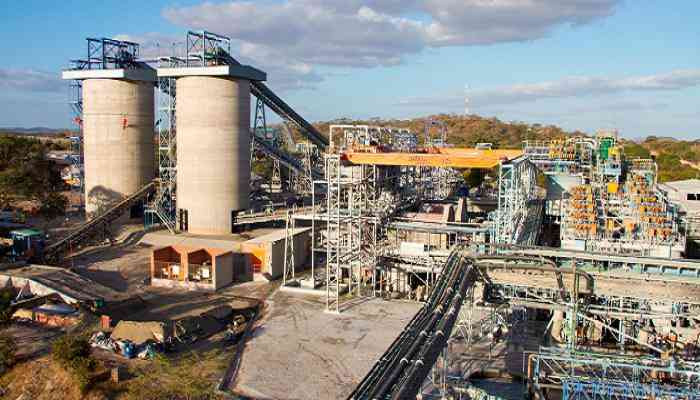
The Herald's headline on 23 April 2026 announced it with the confidence that such headlines always carry: Manufacturing Recovery, Capacity Utilisation Hits 57 Per Cent. The same number, give or take a point, has been announced before. In 2011 it was 57 per cent, a figure celebrated as proof that the multicurrency system had rescued industry from the abyss of 10 per cent in 2008. In 2021 it was 56.3 per cent. In 2022 it was approximately 56.25 per cent. In 2024 it fell back to 52.3 per cent. And now it is 57 per cent again, and the headline calls it a recovery.
Zimbabwe's industrial narrative has been telling essentially the same story for fifteen years. The number oscillates between the low fifties and the high fifties. It falls, and there is concern. It rises, and there is optimism. But nobody in this recurring conversation has publicly grappled with the question that the number itself cannot answer, which is: 57 per cent of what?
Capacity utilisation measures how much of installed productive capacity is being used. The denominator in that fraction is the capacity that exists. And in Zimbabwe, that capacity was largely designed, built, and calibrated for an economy that no longer exists, serving a population less than half the size of the one that lives here now, producing goods for a market structured entirely differently from today's. To celebrate progress towards a ceiling built for someone else's economy is not a recovery story. It is a category error.
What the Number Actually Measures
The Confederation of Zimbabwe Industries produces an annual manufacturing sector survey that is, by some measures, the most comprehensive data set on Zimbabwean industry available. It is widely cited, frequently quoted, and has genuinely improved in rigour over the years, with a sample size that reached 409 companies in the 2022 survey, covering firms that are not limited to CZI members and capturing performance across the country.
But capacity utilisation, even in the best-conducted survey, is not an objective measurement. It is a self-reported estimate. Each firm's management is asked to state what percentage of its installed capacity it is currently using. That estimate is shaped by the manager's reading of demand conditions, electricity supply, raw material availability, forex access, and tax policy in the period of the survey. In Zimbabwe's volatile macroeconomic environment, all of those variables change rapidly, making reported capacity levels inconsistent and unreliable across time. A firm that reports 60 per cent in one quarter may be reporting against a very different baseline than the firm next door doing the same.
More fundamentally, the denominator is not standardised. What counts as 100 per cent capacity? It is typically the firm's own assessment of what it could produce if it were running fully. But that assessment is bounded by the equipment the firm actually possesses, not the equipment an efficiently scaled modern operation would require. A manufacturer running ageing 1970s machinery at what it judges to be 85 per cent of that machinery's theoretical output is being counted as a high performer, even if the machinery in question cannot produce competitively priced goods by any regional or international standard.
The Zimbabwe Mail, in a sharp analysis published in November 2025, put the problem plainly: high utilisation figures have frequently reflected firms stretching obsolete equipment due to limited access to capital, foreign currency, and affordable credit. In practical terms, a company running at 85 per cent capacity may simply be straining an old system to meet demand, not preparing for industrial expansion.
- Mthuli Ncube abandons struggling consumers
- Fears of jobs carnage as crisis deepens
- Fresh warning over bank rate hikes
- Police admit that money changers are untouchable
Keep Reading
The Economy the Capacity Was Built For
To understand why the denominator in Zimbabwe's capacity utilisation fraction is so problematic, you have to understand the economy that created it.
By 1980, Zimbabwe had become the second-most industrialised country in sub-Saharan Africa. That was not an accident of geography or resource endowment. It was the deliberate result of a settler colonial economy that had, since the Unilateral Declaration of Independence in 1965, been forced by international sanctions to industrialise rapidly as a substitute for trade. When you cannot import, you manufacture. The Rhodesian manufacturing sector grew precisely because it had no choice, and by 1979 it could supply nearly 90 per cent of the manufactured goods consumed within the country. The population for whom that industrial base was designed was approximately 7.5 million people in 1980, of whom the consumer economy effectively served a small fraction, primarily the 270,000 white Rhodesians and a limited number of urban black Zimbabweans with formal-sector incomes. The factories were sized, the supply chains organised, and the product ranges calibrated for that demand. A textile mill in Bulawayo in 1978 was not producing for 17 million people. It was producing for a racially stratified consumer market of perhaps two or three million.
Zimbabwe's population today is approximately 17.4 million. The median age is 18.3 years. More than 42 per cent of the population is under 25. This is a country whose population has more than doubled since the industrial infrastructure was built, whose demographic centre of gravity has shifted entirely, and whose consumption patterns, income distribution, and geographic concentration of demand have been transformed beyond recognition. The factories are still there. The machines are older. But the people they were built to serve have changed entirely.
At independence, Zimbabwe's manufacturing sector contributed 23 per cent of GDP. By 2009, it had collapsed to single digits. By 2023, CZI's own reports showed it at 9 per cent of GDP, before a partial recovery brought it to approximately 11 per cent. The sector now, by the government's own Mid-Term Budget figures, contributes 15.3 per cent of GDP, which is cited as evidence of a resurgence. But 15 per cent of a much larger nominal economy is not the same industrial weight as 23 per cent of the smaller economy of 1980. The sector has not recovered. It has stabilised at a structurally lower level, in relation to both the overall economy and the population it theoretically serves.
The Trap in the Metric
Here is the trap that 57 per cent capacity utilisation sets for policymakers, industrialists, and the public: it implies that the goal is to get to 100 per cent. If you are at 57 per cent, the solution is to use more of what you have. Produce more. Remove the blockages. Get the power on. Fix the forex. Unlock the working capital. And then, the logic goes, 57 per cent becomes 70 per cent, and Zimbabwe's manufacturing sector is healthy.
But this framing assumes that the capacity is the right capacity, that the installed base is the right installed base, that the product mix is the right product mix, and that running the existing machinery harder represents genuine industrial development. None of those assumptions survives scrutiny.
Zimbabwe's manufacturing sector requires an estimated US$8 billion in working capital and equipment upgrades to become genuinely competitive. That is not a figure for expanding capacity. That is the figure for making existing capacity functional at modern standards. In sectors like cement, sugar, and beverages, where capacity utilisation figures often appear encouraging, the underlying machinery is frequently obsolete, and output cannot compete internationally without protection. A company running at 80 per cent of a sub-competitive machine's output is not industrialising. It is persisting.
The CZI survey itself has occasionally acknowledged this tension. In its 2024 survey, the chief executive Sekai Kuvarika described unused capacity as a missed economic opportunity, arguing that unlocking 50 per cent more capacity could raise manufacturing's GDP contribution from 11 per cent to 15 per cent. The logic is arithmetically coherent. But it is also politically safe. It does not require asking whether the capacity being unlocked is the capacity Zimbabwe needs for 2026, or whether it is a legacy industrial base calibrated for a different century, a different population, and a different trade environment.
The more uncomfortable question is what happens when firms run hard against their existing capacity ceiling. The Zimbabwe Mail analysis noted that unlike in developed economies, where high utilisation triggers new investment, in Zimbabwe it can indicate capital constraint. High interest rates, chronic foreign currency shortages, and policy unpredictability discourage investment in new plants, machinery, and technology. A company at 85 per cent capacity may simply be unable to afford to go higher. The ceiling is not aspiration. It is imprisonment.
Fifty-Seven Per Cent of an Economy That Left
There is another dimension to the denominator problem that is almost never discussed: the companies that have closed are no longer included in the survey.
Between 2000 and 2010, Zimbabwe's formal manufacturing sector contracted catastrophically. Factories closed, entire sub-sectors collapsed, and the men and women who had worked in them moved into the informal economy or emigrated. The Bulawayo industrial complex, once the engine of manufacturing in the region, shed firm after firm. Textiles, footwear, clothing, leather goods, and metal fabrication in particular were devastated. By the time the CZI's surveys resumed in any meaningful form after dollarisation in 2009, they were measuring a survivorship-biased sample. The firms that had closed were no longer respondents. The capacity they had once represented was no longer in the denominator.
This is not a conspiracy or a flaw in CZI's methodology. It is an inherent limitation of any survey-based measure of an industry that has contracted. If the weakest firms exit, the average of the survivors rises, and the reported capacity utilisation can look more impressive than the underlying industrial reality warrants. The 57 per cent figure describes the firms that survived. It tells us nothing about the capacity that was lost and has never been rebuilt.
The Volume of Manufacturing Index, a measure of actual changes in production volumes, has been declining since 2009, even in years when capacity utilisation figures rose. That divergence is the signal. When utilisation goes up but actual volume goes down, it means the sector is using a larger fraction of a shrinking base. That is not recovery. That is contraction made legible through a misleading statistic.
The Population That the Factories Were Not Built For
Zimbabwe in 2026 has 17.4 million people. More than a third of them live in extreme poverty. The median age is 18 years. Over 76 per cent of economic activity happens in the informal sector. The formal manufacturing sector, whose capacity utilisation figures make headlines, serves a consumer base that has been radically reshaped since those factories were built.
Consider what this means for the denominator. A textile mill built in 1972 to supply a market of 270,000 middle-class consumers with formal-economy incomes is now operating in an economy where the vast majority of potential customers buy second-hand clothes at tuckshops, where the competition is not a rival domestic manufacturer but a shipping container from China or a bale from a European charity, and where disposable income is so compressed that buying a locally manufactured shirt at a competitive margin is not a realistic aspiration for most households. Running that mill at 57 per cent of its 1972-designed capacity and calling it industrial recovery is, at minimum, an incomplete description of what is happening.
The CZI's own surveys have consistently flagged this demand problem. The clothing and footwear sub-sector has persistently been among the worst performers in capacity utilisation, not because it cannot produce, but because it cannot sell. It faces import competition that includes smuggled products and second-hand clothes that absorb the demand that locally manufactured goods need to survive. No improvement in capacity utilisation addresses this. A factory running at 70 per cent instead of 40 per cent is still losing market share to imports if the underlying cost structure, product quality, and price point are uncompetitive.
The formal sector is producing for a consumer who has largely abandoned it. The informal economy, which accounts for 76 per cent of GDP according to ZimStat, has built its own supply chains, its own distribution networks, and its own pricing logic. That economy is not going to return to formal-sector manufacturing simply because capacity utilisation rises. It is served by tuckshops, informal traders, and imported goods, precisely because the formal sector cannot match the price or the accessibility. Capacity utilisation in the formal sector tells you nothing about what the other 76 per cent of the economy is doing or buying.
What a Genuinely Useful Metric Would Tell Us
Zimbabwe is not alone in being poorly served by capacity utilisation as a primary industrial indicator. The limitations of the metric are well-established in economic literature. It measures intensity, not expansion. It measures what is, not what should be. And in economies with ageing capital stock, it conflates utilising what exists with building what is needed.
What would a genuinely useful set of industrial indicators look like for Zimbabwe in 2026? It would start not with what percentage of existing capacity is in use, but with a different set of questions entirely. What is the actual volume of manufacturing output in constant-price terms, and how does it compare to 1990, 1980, and 1970? What percentage of domestic demand for manufactured goods is met by domestic production, as opposed to imports? What is the age profile of capital equipment across the manufacturing sector, and what fraction of it would meet the standards of a modern competitive producer? What is the export-to-output ratio, and how does it compare to regional peers? And perhaps most pointedly: what is the sector producing per capita of the population it is supposed to serve?
The CZI noted in its 2024 survey that only 5 per cent of the manufacturing sector is currently exporting. That is the most revealing figure in the entire report, and it attracted far less attention than the capacity utilisation number. A manufacturing sector that supplies 95 per cent of its output to the domestic market, in a country where domestic demand is structurally compressed and import competition is intense, is not an export-oriented industrial base. It is a protected, inward-looking sector surviving on captive demand and government incentives. That is a different story from the one that 57 per cent capacity utilisation tells.
Zimbabwe's manufacturing sector contributed US$10 billion to GDP in its peak decade of the 1980s. Restoring that is not a matter of unlocking unused capacity in existing factories. It requires new investment in new technology for a new population with new needs, in industries that can compete regionally and globally rather than surviving behind the walls of import controls and buy-local campaigns. The question is not how to fill the old factories. It is whether the old factories are the right factories.
The Honest Conversation
There is a reason the capacity utilisation figure endures as the primary headline measure of Zimbabwe's industrial health. It is because it is the most optimistic number available. In a sector where output volumes have been declining, where export orientation is negligible, where capital stock is ageing, and where the population has fundamentally outgrown the designed capacity of the installed base, 57 per cent is the number that sounds closest to normal.
But normal, in this context, is Rhodesian. The capacity that Zimbabwe's industry is 57 per cent of was designed by and for a settler colonial economy, calibrated for a fraction of the current population, and has been depreciating, both physically and in economic relevance, for more than four decades. Celebrating proximity to that ceiling is not an industrial recovery narrative. It is a form of nostalgia dressed as progress.
The honest conversation about Zimbabwe's manufacturing sector would begin with a different question: not how do we get to 100 per cent of what we have, but what do we actually need to produce, for whom, at what scale, and with what technology, to serve 17 million people in 2026 and the 25 million people that Zimbabwe will have by 2040? That question requires new investment, not the activation of old machines. It requires an industrial strategy oriented around the population that exists, not the market that the factories were designed for.
Until that conversation begins, 57 per cent will keep appearing in headlines, and it will keep meaning what it has always meant: that Zimbabwe's industry is running at just over half of a capacity that was built for someone else's country. That is not a recovery. It is the persistent residue of a colonial industrial base that the economy has never found the resources, the will, or the clarity of purpose to replace.
The headline is not wrong. The number is accurate. The problem is the story the number is being asked to tell.