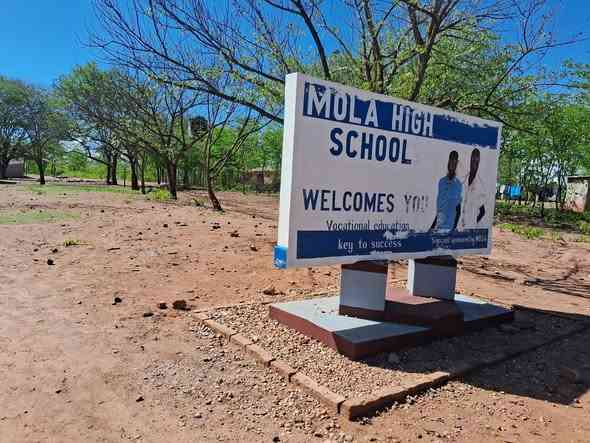
My mind turned back to my high school days at Mola Secondary School some 33 to 34 years ago. I was an outsider, arriving in a remote community to learn for two years and then leave. But like any schooling experience, those two years were eventful. They were formative in ways I could never have imagined.
The brown library was our sanctuary. It was dim, sparsely stocked, and modest by any standard. Yet it was everything to us. Commissioned in 1992, it stood as a symbol of pride on the edge of the wilderness, where mopani forests met red, cracked earth.
In winter, the landscape was harsh and haunting. Leaves disappeared, and the ground split into jagged fissures. When the rains came, the mud would heal dramatically, swallowing the debris of the dry season before hardening again under the unforgiving sun. Mosquitoes and scorpions thrived in those cracks. They are natural inhabitants of one of Zimbabwe’s hottest and driest regions.
By the time I arrived, the library stood beside a thorn-ridden football pitch. In spring, the area would briefly bloom, offering a refreshing escape from the monotony of note-taking — a glimpse into nature’s quiet brilliance. But the environment was never entirely benign.
The school itself had too few classrooms. For much of Form Four in 1993, we learned under a thatched shed. When it rained, we would dash to the library, though even there, storm clouds often made it too dark to read the chalkboard.
Still, I spent countless hours in that space, devouring books and nurturing a deep love for history, current affairs and journalism.
At weekends, our journeys back to Chalala or Bumi Hills were equally unforgiving. We walked long distances across the blistering terrain of a national park, our feet hardened by necessity. At Bumi Hills, we would pause to take in the vastness of Lake Kariba, its waters stretching endlessly, merging into Zambia and winding eastward.
Mola was no ordinary place. It was a landscape of both beauty and peril. There were stories that stayed with me.
- Malaria fight disrupted by COVID pandemic: WHO
- Malaria fight disrupted by COVID pandemic: WHO
- Co-operate to curb malaria, Mash West farmers urged
- Vaccines could be a game-changer in the fight against malaria in Africa
Keep Reading
One told of a woman who survived a brutal buffalo attack. Left unconscious and severely injured, she lay alone in the wilderness as dusk approached. By sheer luck, she survived.
That is why last Saturday’s report by the NewsDay newspaper on mysterious deaths in Mola was not just disturbing. It was deeply personal. It took me back more than three decades.
In 1992, there were whispers, stories of people suddenly falling ill, vomiting blood and dying. The cases were not widespread, or at least they did not appear so. But the accounts often came up and never fully explained.
Today, those whispers have evolved into a crisis.
As the NewsDay reported, villagers in Ward 1 are living in fear, haunted by cases of the sudden illness and deaths. The symptoms — dizziness, abdominal swelling and vomiting blood, according to NewsDay — are chillingly familiar.
What makes this even more striking is that the Member of Parliament, Shine Collins Gwangwaba, and the local councillor, Goodward Siabwanda — both cited in the report — are people I once shared a classroom with. Gwangwaba would later pursue a career in nursing, while Siabwanda still teaches there.
This is no longer a distant story. It is a crisis unfolding in a place that shaped me, affecting people whose journeys intersected with mine. And it raises a deeply troubling question. How does a condition that existed in whispers in 1992 remain unresolved in 2026?
This is not merely a health issue, but an indictment of systemic neglect.
Gwangwaba himself acknowledges that these deaths “have been part of us” for generations, once dismissed as witchcraft. Today, despite advances in medical science, the situation appears no closer to resolution. That failure points directly to the state.
Reports indicate that Health minister Douglas Mombeshora was unaware of the crisis, while his deputy acknowledged it without outlining a clear response. Meanwhile, families continue to bury their loved ones.
This is unacceptable.
A government that reacts only when tragedy becomes impossible to ignore has already abdicated its responsibility. Leadership demands foresight, not belated response.
The conditions I witnessed as a student in Mola offer context to today’s crisis.
Students walked more than 20 kilometres to school, often without adequate food. The clinic was understocked — sometimes non-functional. Pregnant women travelled long distances in search of care.
I do not recall encountering a single doctor during my time there. Malaria outbreaks were common and devastating.
Even then, the foundations of today’s crisis were visible — a fragile health system, poor access to clean water and communities left largely to fend for themselves.
What makes this even more tragic is that the region is not devoid of resources. The broader Zambezi Valley is rich in coal, timber, wildlife, and now methane gas. Yet the people of Mola remain trapped in poverty, disconnected from basic services. It is a classic case of the resource curse: wealth flows outward, while suffering remains.
Over the years, I have heard from friends and former classmates that these mysterious illnesses have become more frequent. Whether driven by environmental factors, population pressures, or prolonged neglect, the reality is clear that the problem has been allowed to fester.
Instead of urgency, there has been silence.
Instead of intervention, there has been delay.
And instead of solutions, there has been a dangerous tolerance for avoidable suffering.
This neglect carries consequences beyond health. It breeds resentment and alienation.
Even during my school years, there was a subtle but unmistakable sense of exclusion. I recall a football match between Zimbabwe and Zambia where some colleagues supported Zambia. On another occasion, when it rained elsewhere in the country, a teacher who grew up in the community remarked: “It is raining in Zimbabwe.”
That statement has never left me.
It reflected a community that felt disconnected from the national narrative not out of disloyalty, but out of neglect. And neglect, when sustained over generations, becomes alienation.
The people of Mola are not asking for extravagance. They are not demanding luxury or excess.
They are asking for basic healthcare, functioning clinics, and access to clean water. They yearn for clear answers about the illnesses claiming lives in their community.
They are asking for dignity. Yet even these modest expectations have gone unmet for decades.
The current health scare should have triggered an immediate and robust response. Medical specialists should already be on the ground while water sources should be tested without delay. Comprehensive screenings should be underway.
Instead, there is hesitation. And hesitation, in a situation like this, costs lives.
The government must act decisively.
As Gwangwaba said, Mola Clinic and Siakobvu Hospital require urgent upgrading and resourcing. Mobile health units must be deployed to reach affected communities. Clean water infrastructure must be prioritised, particularly in areas linked to suspected contamination sources such as the Siamuyala River.
Equally important is transparency.
Communities must be kept informed. In the absence of clear information, speculation and fear will fill the void. Trust can only be rebuilt through consistent engagement and openness.
In the longer term, this crisis must be understood within the broader context of rural marginalisation in Zimbabwe.
From Binga to Nyaminyami, many communities remain on the periphery of development despite sitting atop significant natural wealth. Infrastructure is weak, and health systems are fragile. Economic opportunities are limited.
This trajectory is unsustainable.
A nation cannot claim progress while entire regions remain excluded.
What is happening in Mola is not an isolated incident. It is a reflection of national priorities, and a warning.
Thirty-four years ago, I arrived in Mola as a student and witnessed a community struggling on the margins. Today, I write as a journalist confronting the painful reality that little has changed.
If anything, the consequences are now more severe. Lives are being lost, families are being broken. A crisis that once existed in whispers is now impossible to ignore.
The regime must wake from its slumber, not tomorrow, and not after another round of statements.
Action is required now.
This is because for the people of Mola, this is not a headline but life and death.