
The reputation of a brand is closely tied to its suppliers. Suppliers should be regarded as more than just suppliers. They are strategic partners who can significantly influence the organisation’s top and bottom lines.
They should be regarded as extensions of organisations. Suppliers have moved from the edges to the centre of how organisations operate. Organisational outputs are only as strong as inputs from suppliers. Suppliers are slowly becoming the core of sustainable business performance.
Success is a team effort. The organisation is only as good as the supply chain partners that surround it. The day-to-day support from vendors is often subtle, quietly pulling the strings behind the scenes. It is so subtle that it often goes unnoticed. In a globalised world, nothing happens in isolation. Suppliers are key.
The vendor selection process therefore stands out as a thread that weaves together efficiency, quality and strategic advantage. Supplier pre-vetting is a systematic process that evaluates a potential supplier’s ability to meet the organisation’s quality, compliance, and performance requirements.
The supplier pre-vetting assessment often involves the cross checking of certification requirements, organisational production capacity, fiscal soundness and capital adequacy, giving an indication of whether prospective suppliers are properly aligned with organisational performance standards.
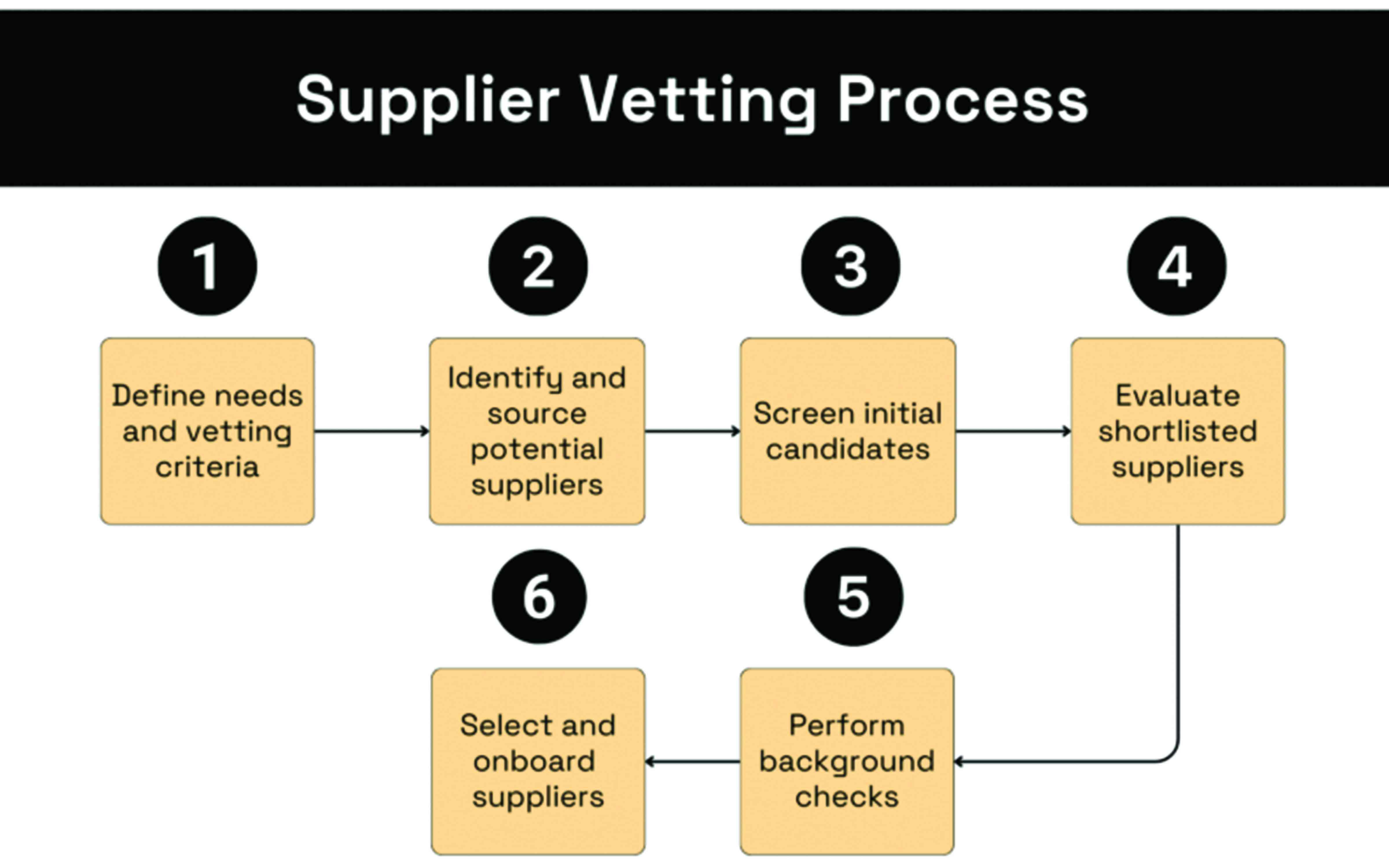
Such a process flow will generate a preferred supplier list which is a curated roster of pre-qualified vendors. Supplier pre-vetting is therefore an intentional, systematic process that involves the pre-selection of prospective suppliers before inviting them to participate in tender processes. This process involves several critical steps, including defining organisational requirements, developing the supplier selection criteria, identification of potential vendors, evaluating vendor proposals and ultimately making a well-informed decision.
Comprehensive supplier vetting is akin to laying a strong foundation for a building. It will seek to guarantee stability and durability. The investment in pre-vetting suppliers will pay for itself many times over. Pre-vetting has become a shorthand for competence.
Supplier pre-qualification also involves assessing a supplier’s historical performance, financial stability, and responsiveness, allowing the business to identify and work with only the best.
- Helping your teen develop good study habits
- DJ Tira takes Kadoma through Gqom lessons
- DJ Tira takes Kadoma through Gqom lessons
- Legal matters: Why it is important to register estates
Keep Reading
Pre-vetting will confirm that the shortlisted suppliers meet the baseline requirements of the organisation. Pre-vetting of suppliers must not be regarded as just another precautionary measure, but should be regarded as a strategic approach to ensure that the business partnerships formed are with supply chain partners that uphold similar values and standards in quality, reliability and ethical practices. The pre-selection process of appropriate vendors involves a careful balance of multiple evaluation criteria.
The emphasis is no longer about who offers the lowest price. It’s not just about finding the lowest vendor. It’s about finding supply chain partners who align with the organisation’s values, ethics and long-term goals.
Supplier vetting is therefore a proactive evaluation process that requires vigilance coupled with a keen eye for detail. Supply chain professionals will be seeking a reassurance that the pre-selected vendors have got the capacity and willingness to always act in the organisation’s best interest, even in the absence of constant oversight.
The practice of supplier vetting is a cornerstone in the architecture of building a supplier’s preferred list that will give long-lasting value at all material times. A preferred supplier’s list will serve as a gatekeeper to ensure that quality standards are preserved. It is a strategic tool that can yield long-term benefits across various facets of a business.
It serves as a seal of approval. The benefits of having a preferred supplier’s list go beyond the bottom line. They focus on demonstrating value beyond competitive pricing. Given the obtaining business environment, the stakes are at their highest than ever.
Organisations can no longer rely on superficial supplier reviews or ratings. The pre-vetting of suppliers should always cross check whether the selected suppliers have got the requisite production capacity and technical capabilities to meet organisational requirements.
Conducting site visits to observe the supplier’s production facilities and processes for purposes of quality control could be part of pre-vetting of vendors. Site visits will allow procurement professionals to assess the organisational operational efficiency and adherence to proper safety standards. This process will filter out unsuitable vendors early on, safeguarding business organisations from potential liabilities. It must, however, be noted that the pre-vetting of suppliers does not guarantee future business.
Completion of such processes is just meant to confirm that the supplier meets the baseline requirements of the organisation. The pre-emptive measures are meant to reassure the organisation that only those vendors who demonstrate the capacity to meet contractual obligations will be eligible for invitation to bid.
The verification of suppliers in advance will assist supply chain professionals from avoiding working with organisations that lack the capacity or experience to fulfil contractual obligations. The rigorous evaluation instils confidence that the short-listed vendors possess the necessary capabilities to perform at the highest level.
There is often a tendency to overlook the cultural fit when pre-vetting suppliers. Organisations are required to build long-lasting mutually beneficial relationships with only those vendors that align with their business philosophy.
Suppliers whose business culture aligns with your organisational values will likely contribute to better synergies, leading to stronger business relationships. The pre-vetting process goes beyond mere price comparison. It is about finding supply chain business partners that align with your organisational values, goals and quality standards.
It is, therefore, a strategic imperative to evaluate the supplier’s commitment to ethical business practices such as fair labour practices, environmental sustainability and anti-corruption practices. Pre-vetting processes must locate best in class vendors that align with organisational values to promote safety, quality, operations, and customer service.
There is need to establish business relationships that can weather the storms of market volatility, unpredictable supply chain disruptions and ever-present spectre of competitive pressures.
Conducting capability assessment of high risk or high spend categories is key. The due diligence processes that are conducted will serve as a frontline defence in ensuring that supply chains remain robust and resilient even under very difficult circumstances. Risk mitigation strategies will assist in the assessment of the supplier’s ability to withstand unforeseen circumstances such as supply chain disruptions.
The process of vetting vendors will seek to transcend mere due diligence. It is a critical component of risk management assessment that is meant to safeguard an organisation’s integrity, reputation and operational continuity. Red flags and warning signs are the critical indicators that signal when it is time to walk away from potential problem suppliers.
These routine checks can be useful in discovering potential red flags which are related to the financial viability of a supplier, effectively sniffing out those suppliers operating from a shaky ground. It is important to remember that the risks associated with vendors are diversified in nature and may manifest at any stage of the vendor life cycle.
Conducting due diligence processes is not only a marker of sound business acumen but also pivotal to maintaining a competitive edge in the market by associating with reliable and high performing suppliers.
A supplier’s reputation in the market can be a telling sign of their reliability and quality. If one of your vendors renegade on quality, your organisation is the one left to pick up the pieces.
It is also highly recommended to carry out a thorough financial audit to assess the supplier’s financial health. It may be necessary to assess the organisation’s debt-to-equity ratio to gauge the supplier’s financial capacity and the potential risk of insolvency.
Supply chain professionals may carry out a financial assessment and discover that a supplier’s current ratio is below acceptable industry standards, indicating potential liquidity issues. Whenever supply chain professionals are evaluating financial offers, it is important to be wary of pricing lists that seem too good to be true or terms and conditions that appear to be overly generous.
Terms and conditions that appear to be too generous could be an indication of underlying issues such as compromised quality or even a sign of financial distress. Such offers, instead of being regarded as potential opportunities, often serve as cautionary red flags.
Supply chain professionals will be required to critically analyse a supplier’s financial statements such as balance sheets and income statements to assess their solvency, liquidity and overall financial stability. This includes examining credit worthiness, financial statements and liquidity ratios to assess the financial capacity of the business.
Nyika is a supply chain practitioner based in Harare, Zimbabwe. — [email protected]