
Perhaps we are not paying enough attention, but in January, a report released by the United Nations University’s Institute for Water, Environment and Health carried a striking warning: humanity has entered an era of “global water bankruptcy.”
The phrase was deliberately provocative. Like a nation that spends beyond its financial means, the world is consuming freshwater faster than nature can replenish it. Rivers, aquifers and lakes are being depleted at a rate that exceeds their natural recharge. The hydrological accounts of the planet are moving into deficit.
The concept, outlined in the UN Report, Global Water Bankruptcy: Living Beyond Our Hydrological Means in the Post-Crisis Era, reflects a structural shift rather than a temporary shortage. For decades, water scarcity was framed as a “crisis,” implying that it might be resolved through emergency measures.
The new language suggests something deeper. A systemic imbalance between demand and supply is becoming embedded in the global economy.
Population growth, industrial expansion, urbanisation and the intensification of agriculture have steadily increased global water demand. Agriculture alone accounts for roughly 70% of freshwater withdrawals worldwide.
Meanwhile climate change is altering rainfall patterns, shrinking glaciers that feed major river systems and intensifying droughts in already fragile regions.
The result is that many parts of the world are approaching, or have already crossed, the threshold where water consumption consistently exceeds sustainable supply. From the American West to Northern China, from the Middle East to parts of South Asia, aquifers are falling, rivers are running dry before reaching the sea and farmers are struggling to maintain production.
It is against this backdrop, that Africa presents one of the great paradoxes of the 21st century.
- Will the IMF US$961m windfall rescue Zim?
- Will the IMF US$961m windfall rescue Zim?
- BCC proposes inquiry into water challenges
- Diarrhoea hits Gweru
Keep Reading
While large parts of the world are confronting water scarcity, Africa remains comparatively rich in natural resources essential to agriculture. Although somewhat dated, a landmark report by the McKinsey Global Institute, Lions on the Move: The Progress and Potential of African Economies (June 2010), observed that Africa holds roughly 60% of the world’s uncultivated arable land suitable for agriculture. In other words, the continent possesses the largest reserve of potential farmland remaining on the planet.
At the same time, the same report confirmed that Africa contains significant freshwater systems, including some of the world’s largest river basins and lake networks. From the Congo Basin to the Nile watershed and the Great Lakes region, the continent holds vast hydrological resources that remain underutilised relative to their potential.
Yet despite these advantages, Africa imports tens of billions of dollars’ worth of food each year.
This contradiction lies at the heart of the continent’s development challenge. Africa’s agricultural constraints are not primarily about natural resource scarcity but about infrastructure, investment, technology and governance. Much of the continent’s farmland remains dependent on rain-fed agriculture, leaving production vulnerable to droughts and erratic rainfall. Irrigation coverage is still limited compared with regions such as Asia or North America, where large irrigation systems transformed agricultural productivity during the 20th century.
The emergence of global water bankruptcy therefore reframes Africa’s role in the future of global food production. As water stress intensifies in other regions, the relative value of Africa’s land and water resources will increase. Countries that possess both arable land and accessible freshwater will become strategically important to the world’s food system.
Within this continental context, Zimbabwe occupies an intriguing position.
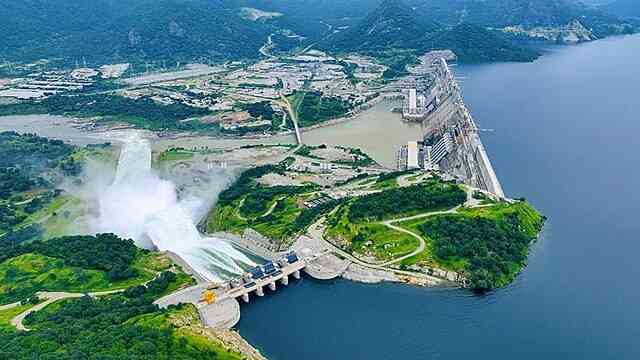
Zimbabwe possesses one of the more extensive water storage infrastructures in southern Africa. Managed under the Zimbabwe National Water Authority (Zinwa, recent statements from the Ministry of Lands, Agriculture, Fisheries, Water and Rural Development indicated that Zimbabwe has 10 600 dams, storing freshwater for agricultural, industrial and domestic use. These reservoirs range from large national assets such as Lake Kariba and Tokwe-Mukosi to smaller regional dams designed primarily to support irrigation schemes.
In principle, such infrastructure provides Zimbabwe with a significant foundation for agricultural resilience. Irrigation systems can buffer farmers against climate variability and declining rainfall reliability, two trends increasingly associated with climate change in southern Africa. Where rain-fed agriculture suffers from drought, irrigated systems have to be deployed in order to stabilise production and support multiple cropping cycles each year.
In a world moving toward water scarcity, this capability could become increasingly valuable.
Countries that can reliably produce food despite climatic uncertainty will occupy a stronger position in global agricultural markets. Irrigation enables higher yields per hectare, greater crop diversification and the cultivation of higher-value crops such as horticultural products, fruits and specialty grains for local consumption and for exports. These crops often generate significantly greater economic returns than traditional staple production alone.
For Zimbabwe, the potential implications are substantial.
If the country were able to fully utilise its water infrastructure through modern irrigation systems, it could significantly increase both food production and agricultural exports. In a water-constrained world, agricultural producers with reliable water access may find expanding opportunities in regional and international markets.
Many of Zimbabwe’s dams require ongoing maintenance, desiltation and modernisation to ensure they operate at full capacity.
Irrigation schemes also depend on reliable electricity supply, well-maintained canals and pumping systems and the technical capacity of farmers to use water efficiently. Without these supporting systems, the existence of dams does not automatically translate into higher agricultural productivity.
There is also a broader lesson embedded in the idea of global water bankruptcy. The warning from the United Nations is not simply about scarcity. It is about sustainability. Many of the regions now facing water crises reached that point through decades of over-extraction, inefficient irrigation practices and poor water governance. If Zimbabwe and other African countries seek to expand irrigation, they must do so carefully to avoid repeating these mistakes.
Modern agricultural technologies provide a pathway forward. Precision irrigation systems such as drip irrigation do reduce water use dramatically while increasing yields. Soil moisture monitoring, improved watershed management and drought-resistant crop varieties further improve water productivity. These approaches allow farmers to produce more food with less water, aligning agricultural expansion with environmental sustainability.
Beyond technology, governance will be critical. Transparent water allocation systems, effective management of dam infrastructure and long-term planning for climate adaptation will determine whether Zimbabwe’s water resources become a driver of prosperity or a missed opportunity.
The broader geopolitical implications should not be overlooked. As global water scarcity intensifies, the geography of food production will shift. Nations with reliable freshwater and available farmland could emerge as central pillars of global food security. Investment flows, agricultural partnerships and supply agreements may increasingly gravitate toward regions capable of sustaining large-scale food production under conditions of growing environmental stress. Africa and Zimbabwe within it, could play a crucial role in that emerging landscape.
But given the current US/Israel war against Iran, future wars might play out in Africa, as those who believe they have more rights and entitlement to world resources, start wars, so that they could occupy Africa’s farm land for cheap, whilst utilising the freshwater resources for agricultural production for export to their water-starved societies offshore.
But natural endowment alone is never enough. History shows that resources only translate into prosperity when they are matched with institutions, infrastructure and long-term vision. The United Nations’ warning about global water bankruptcy should therefore be understood not only as a crisis but a signal. It highlights the growing importance of water as a strategic resource in the global economy.
Conclusion
For Zimbabwe, the presence of many dams and substantial freshwater reserves represents more than a legacy of past engineering projects. In an increasingly water-constrained world, it may represent one of the country’s most important strategic assets.
The challenge now is to transform that asset into sustainable agricultural growth and in doing so, help feed a world that is rapidly approaching the limits of its water account.
Ndoro-Mukombachoto is a former academic and banker. She has consulted widely in strategy, entrepreneurship, and private sector development for organisations in Zimbabwe, the sub-region and overseas. As a writer and entrepreneur with interests in property, hospitality and manufacturing, she continues in strategy consulting, also sharing through her podcast @HeartfeltwithGloria. — +263 772 236 341.