
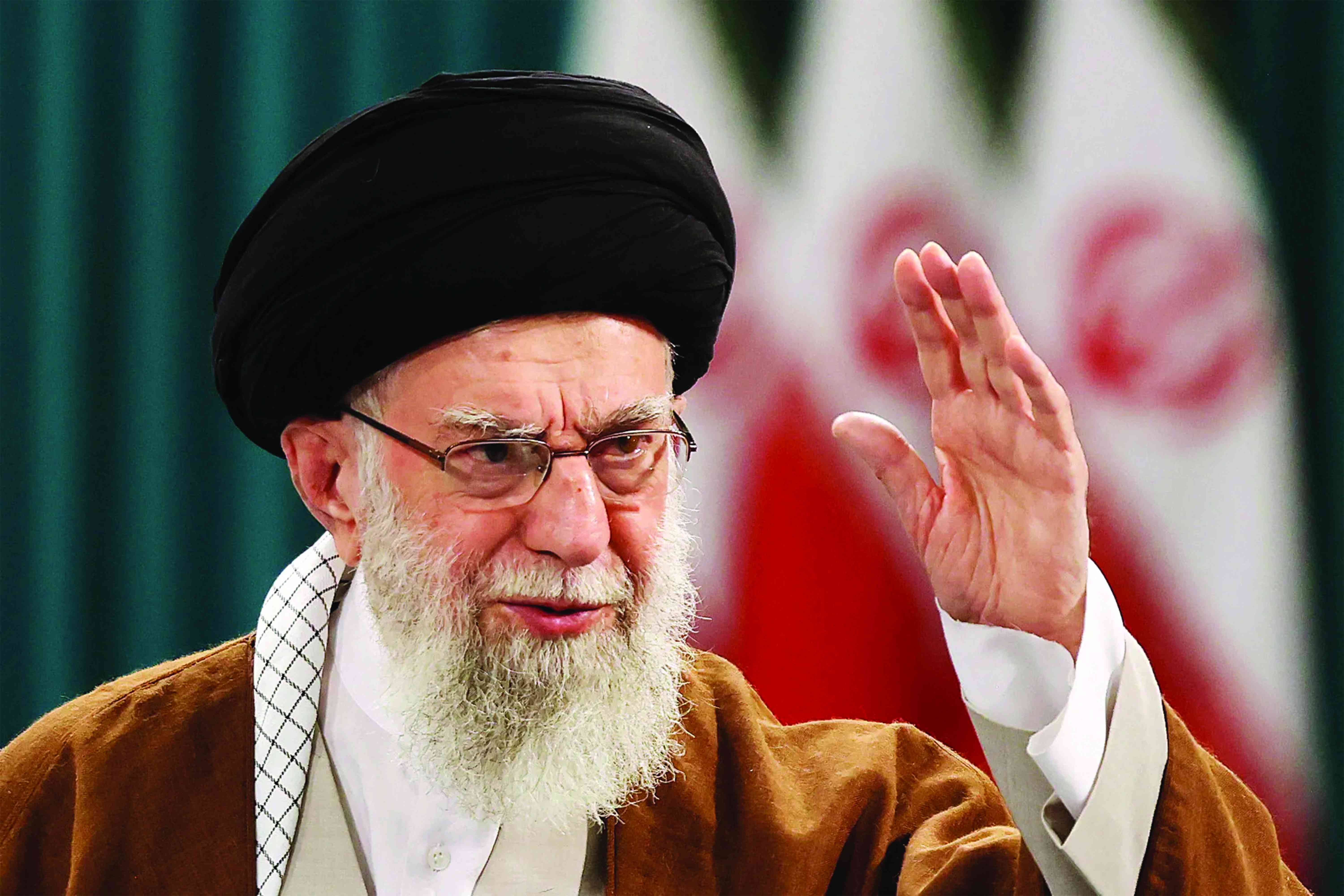
In the morning of the 1st of March, 2026, we woke up to news channels across the globe announcing the US/Israel strikes against Iran. But what we know in geopolitics is that, coincidence is often the least persuasive explanation.
When events of immense magnitude erupt simultaneously, each capable of commanding global attention in its own right, the question is not simply what is happening, but what is being eclipsed in the process.
What I have come to call “The Grand Distraction” is not a conspiracy theory. It is a structural observation about power, timing and the management of public attention in an era when narrative velocity often determines political consequence. Consider the reported joint military action by the US and Israel against Iran — an operation said to have resulted in the death of Iran’s Supreme Leader, Ayatollah Ali Khamenei, alongside senior figures within the Iranian state and the Islamic Revolutionary Guard Corps (IRGC).
Israeli officials released names such Aziz Nasirzadeh, Defence Minister Ali Shamkhani, Secretary of Defence Council Mohammad Pakpour, the IRGC commander and Lt. General Abdolrahim Mousavi among others, linked to Iran’s strategic decision-making.
The scale and precision of the attack have shocked world capitals and provoked immediate retaliation from Iran with missile and drone strikes across the region, heralding a dramatic escalation in a conflict that has already reshaped Middle Eastern geopolitics.
If accurate, such an event would constitute one of the most consequential political assassinations of the twenty first century. The removal of a sitting head of state through external military force would not merely alter regional dynamics. It would redraw the architecture of deterrence, sovereignty and precedent.
The global response has been immediate and visceral: markets trembling, oil futures spiking and diplomatic channels flaring up with urgency. Media cycles continue to saturate themselves with missile trajectories, satellite imagery and speculation about retaliation. The language of escalation is dominating headlines. It is the sort of event that reorders the hierarchy of global concern overnight.
Renewed scrutiny of elite networks
- A Clearer View: The grand distraction
Keep Reading
Yet running almost parallel to this geopolitical earthquake is another unfolding drama, quieter in spectacle, but no less explosive in implication. Newly-disclosed materials linked to the late financier Jeffrey Epstein have reportedly prompted renewed scrutiny of elite networks and historical associations.
Central among these developments has been the arrest of Andrew Mountbatten-Windsor, formerly Prince Andrew, on allegations connected to misconduct in public office. The symbolic weight of such an arrest, touching the British royal family and raising questions about access, privilege and institutional protection, would ordinarily command relentless examination.
Exploiting the ecology of attention
These are two extraordinary events — one global in its military ramifications — the other domestic but deeply institutional in its implications. And yet the former, by sheer magnitude and immediacy, swallows the latter almost whole.
This is the premise of The Grand Distraction. It is not the fabrication of events, but the leveraging of scale. When catastrophe erupts, especially in the form of war, including assassinations, it exerts gravitational pull on public consciousness. Scandal, even at the highest levels, cannot compete with the spectacle of armed conflict. Missiles outpace court filings. Explosions drown out testimony. The dramatic eclipses the systemic.
It would be naïve to suggest that complex geopolitical operations are launched merely to bury inconvenient news cycles. History offers little support for such simplistic causation. But it would be equally naïve to ignore how power structures understand and exploit the ecology of attention. Governments, intelligence agencies and political actors operate in a world acutely sensitive to optics. Strategic timing is not incidental to statecraft, it is embedded within it.
The modern media environment intensifies this dynamic. Information no longer arrives in measured intervals. It collides. Algorithms privilege urgency and threat. When audiences are overwhelmed, cognitive triage sets in, that is, the immediate danger takes precedence. War displaces accountability. Security supplants scrutiny.
An era of conditional sovereignty
But beneath the competition for headlines lies a deeper issue — legality. If a sovereign leader has indeed been killed by foreign military action in the absence explicit multilateral authorisation, the implications are profound.
The prohibition against the use of force is foundational to the post-1945 international order, codified most prominently through the United Nations and the charter framework that governs relations between states. Exceptions exist. Self-defence against armed attack and collective security mandates are provided for, but they are tightly circumscribed.
The erosion of those constraints, whether through reinterpretation or outright circumvention, alters more than one conflict. It recalibrates precedent. If powerful states determine unilaterally that another nation’s leadership constitutes a legitimate military target, then the principle of sovereignty becomes conditional. And conditional sovereignty is sovereignty in name only!
Morality and legality
Some will argue that the nature of the Iranian regime, its regional activities or its internal repression renders such measures morally defensible. Others will contend that extraordinary threats require extraordinary responses. These arguments are not trivial. They reflect genuine anxieties about security and stability. But morality and legality are not synonymous.
A world order governed by ad hoc justifications, however emotionally compelling, becomes a world in which rules apply selectively.
And selectivity breeds replication. If the killing of a head of state can be justified by one coalition under the banner of pre-emption or stabilisation, what prevents another power from invoking similar reasoning? The logic is easily portable. Russia has already demonstrated a willingness to frame its own military interventions through narratives of defensive necessity. The more flexible the interpretation of international norms becomes, the more pliable they are for all. This is not a defence of any regime. It is a defence of coherence.
Epstein network erodes public trust
Meanwhile, the quieter scandal — allegations of elite misconduct, institutional shielding, and possible corruption — pose a different but related threat to democratic legitimacy. Public trust erodes when citizens suspect that accountability is tiered: harsh for the powerless, negotiable for the influential. The Epstein network has long symbolised that suspicion. Each new disclosure revives a lingering question: who knew what and who was protected?
If such scrutiny dissipates under the shadow of geopolitical crisis, the cost is not merely journalistic imbalance. It is institutional memory. Democracies depend on sustained attention to uncomfortable truths. When those truths are displaced before they are fully examined, reform falters. The Grand Distraction, then, is not about denying the reality or gravity of war. It is about recognising how the architecture of attention can reorder public priorities in ways that serve entrenched power. The spectacle of conflict becomes a solvent. It dissolves sustained focus elsewhere.
The seduction of binary narratives
There is an additional psychological dimension. External threats consolidate internal unity. When a nation perceives itself at risk, dissent often softens. Political opposition moderates its tone, media outlets recalibrate their coverage and citizens rally around symbols of stability. This reflex is deeply human. It is also politically useful.
Yet the health of democratic societies depends precisely on their capacity to hold multiple truths simultaneously: to confront external crises without abandoning internal accountability, to debate legality even amid fear and to resist the seduction of binary narratives. We must also resist intellectual laziness. Not every concurrence of events is engineered. The world is volatile, overlapping crises are, in some sense, inevitable. But the responsibility of an informed public is to interrogate patterns without collapsing into paranoia. Vigilance does not require conspiracy, it requires curiosity.
Therefore, what narratives ought to be amplified? Which ones are to be deferred? Who benefits from the reallocation of scrutiny? The answers may not reveal orchestration. They may reveal something subtler: a system predisposed to favour spectacle over structure. That predisposition alone warrants concern. If international norms continue to fray, the long term consequence will not be a safer world but a more unpredictable one. If domestic accountability continues to be eclipsed by episodic crisis, trust in institutions will further corrode. And when trust erodes, polarisation accelerates.
The Grand Distraction is ultimately a warning about fragility — legal fragility, institutional fragility and attentional fragility. It urges citizens not to avert their gaze from war, but neither to allow war to monopolise it. It asks that we examine both the missile strike and the court docket, essentially scrutinising both the battlefield and the committee hearing. Power thrives in darkness and in noise. The former conceals, the latter overwhelms. A mature democracy must resist both.
Conclusion
In an age defined by velocity, the act of sustained attention becomes almost radical. Do we insist on legality even when the outcome feels convenient? Or do we demand accountability even when headlines scream of conflict? Do we question precedent even when fear tempts silence? When we fail to answer these questions adequately, we risk normalising a world where might determines legitimacy and spectacle determines memory. And once that normalisation sets in, reversing it becomes exponentially harder. For citizens and nations alike, the stakes could not be higher.
- Ndoro-Mukombachoto is a former academic and banker. She has consulted widely in strategy, entrepreneurship, and private sector development for organisations in Zimbabwe, the sub-region and overseas. As a writer and entrepreneur with interests in property, hospitality and manufacturing, she continues in strategy consulting, also sharing through her podcast @HeartfeltwithGloria. — +263 772 236 341.