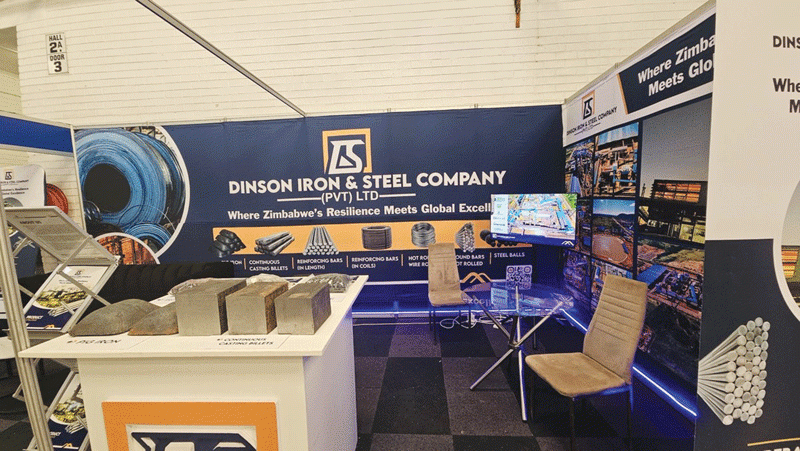
THE air in the Midlands does not smell like the bush anymore. It smells like sulfur, hot grease and the unmistakable, metallic tang of an empire being forged.
Stand on the edge of the Dinson Iron and Steel complex today, and you are not just looking at a US$1,5 billion investment. You are looking at a mirror.
For 23 years, Zimbabwe has tried to “policy” its way out of poverty. We have tweaked interest rates, debated currency denominations and courted donors with the desperation of a jilted suitor.
But the math remained stubbornly, cruelly the same: We dug rocks out of the ground for pennies and bought them back as rebar for dollars.
Manhize is the end of that era. Or it should be.
Power of making
Right now, as you read this, Zimbabwe’s wealth is leaking. Every time a new bridge rises or a mine expands, we ship roughly US$1 billion a year across our borders to buy steel. We have been essentially paying other nations to employ their children and build their infrastructure using our own mineral wealth.
There is a fundamental truth that the “laptop class” of economists often forgets: A nation that makes nothing, owns nothing. For too long, our economic growth has been a ghost, found in the “services sector” or the volatile swings of the tobacco floor.
- Africa’s ‘largest’ ferrochrome plant takes shape
- System Tazvida’s grave vandalised
- Africa’s ‘largest’ ferrochrome plant takes shape
- System Tazvida’s grave vandalised
Keep Reading
But services do not build middle classes; factories do. Manhize represents a “productivity reset”. It demands that we stop being a supermarket for the world and start being its workshop.
By producing 1,2 million tonnes of carbon steel annually in this current phase, we are not just saving foreign currency (forex); we are installing the skeleton of a modern state.
Multiplier: Steel the master key
The brilliance of steel is not just in the metal itself; it is in what happens after the metal leaves the yard. Economists call it the “multiplier effect”, but in the Midlands, they call it survival.
For every one job created inside the Manhize gates, the industry typically generates seven to 10 jobs downstream. By 2026, the “Manhize Multiplier” is expected to catalyse a US$5 billion ecosystem.
We are talking about the rebirth of foundries in Bulawayo, the surge in engineering firms in Harare, and the sudden viability of local automotive assembly.
If we have local steel, we suddenly have cheaper nails, cheaper wire, cheaper ploughs, and cheaper high-rise frames. The cost of every house, every dam, and every warehouse in Zimbabwe just dropped. That is just not a “stat”; it is the ignition of a dormant engine.
Employment: 25 000-job promise
The numbers are staggering. In 2026, Disco has scaled its direct workforce to over 6 000 employees, 95% of whom are Zimbabwean.
But the broader vision is the 25 000 direct and 150 000 indirect jobs projected as the Special Economic Zone matures.
However, the political class must ask: Are we training for these jobs, or are we just watching them happen? The promised Pan-African Science University at the site must be more than a press release.
It must be a factory for metallurgical engineers. If the top-tier technical roles remain occupied by foreign specialists because our own polytechnics are still teaching 1980s curricula, then we have not achieved industrial sovereignty — we have just rented it.
Cost of development progress
You cannot build a “smart city” without ruffling the feathers of the old world. In the villages of Mushenjere and Nyikavanhu, the “reset” is personal.
Some families have moved into new, solar-powered homes built by the company, a massive upgrade from mud-and-thatch.
Others look at the dust on their remaining crops and the fences around their old grazing lands and wonder if they were the price of progress.
The government must answer a piercing rhetorical question: Is this a project for the people of Chirumhanzu, or is it a project that just happens to be in Chirumhanzu?
Corporate social responsibility cannot be an afterthought of “US$200 cushions”. It must be the integration of these communities into the value chain. If a local farmer is not selling his produce to the 6 000 hungry workers in the plant’s canteen, we have failed the community.
Questions for cabinet
If the political class believes that simply cutting a ribbon at a blast furnace is the finish line, they have misread the room. The real work starts now.
The Cabinet must stop asking if we can grow and start asking the “pivot questions”:
l The railway question: We can make five million tonnes of steel by 2030, but how do we move it? If the National Railways of Zimbabwe remains a relic of the 1950s, Manhize becomes an island of productivity in a sea of logistical paralysis. Are we prepared to privatise the tracks to save the industry?
l The power tax: Steel is essentially “congealed electricity”. The plant’s demand will soon exceed 500MW. When the furnace is hungry, will the government choose to keep the lights on in the suburbs or the heat on in the furnace?
l The local content test: Will we have the courage to mandate that every government-funded road, dam, and clinic be built exclusively with Zimbabwean steel? Or will we continue to let “cheaper” foreign imports undercut our own workers?
Zim as foundry
In 2026, the geopolitics of Southern Africa has shifted. With the African Continental Free Trade Area in full swing, Zimbabwe is no longer a landlocked country, it is a “land-linked” industrial hub.
We are the primary supplier to Zambia’s mines, Mozambique’s ports and Malawi’s cities.
We stop being the “sick man of Sadc” and become its foundry. But this requires a terminal end to the “middleman” culture that inflates costs.
We cannot allow a cabal of “tenderpreneurs” to sit between the Manhize gate and the construction site, adding 30% to the price for doing nothing.
Conclusion: Forge is open
The “green steel” advocates in Europe will talk about carbon footprints, and they are not wrong. But for a woman in Mvuma finally seeing her son employed as a welder, the most important colour is not green — it is the orange glow of molten iron.
We have spent decades talking about “Vision 2030”.
In Manhize, the vision is no longer a powerpoint; it is a 2 000-degree reality. We are finally making something again.
The only question left for the men and women in the corridors of power is: Do you have the stomach to protect what we have built, or will you let this moment melt away?
The forge is open. The iron is hot. It is time to strike.
- Dr Nota is an economist and public health expert with a PhD. These weekly New Horizon articles published in the Zimbabwe Independent are coordinated by Lovemore Kadenge, an independent consultant, managing consultant of Zawale Consultants (Private) Limited, past president of the Zimbabwe Economics Society (ZES) and past president of the Chartered Governance & Accountancy Institute in Zimbabwe. — [email protected]/ cell: +263 772 382 852.