
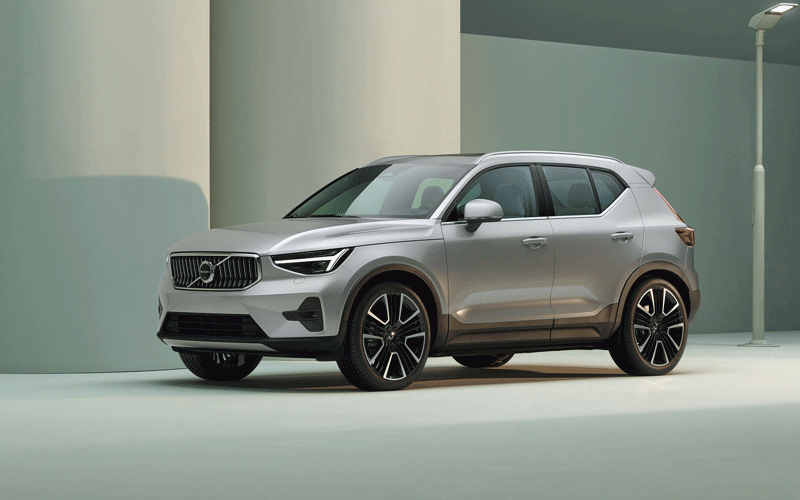
THE Volvo XC40 is a compact SUV that feels like it was designed by people who value calm over drama.
It does not try to be the sharpest-handling option in the class, and it does not lean heavily on rugged “adventure” styling either.
Instead, it majors on what Volvo does best: A quietly premium cabin, strong safety tech, and a relaxed driving character that suits real life — traffic, rough patches of tar and the occasional gravel detour.
In Zimbabwe, you are unlikely to buy one through an official dealer network, but you will see a reasonable number of grey imports (often from the United Kingdom, Japan, or elsewhere). That reality shapes the buying decision: Condition, spec verification and parts planning matter as much as the way it drives.
At about 4,4 metres long, the XC40 is an easy size to live with in Harare or Bulawayo — small enough to park without stress, tall enough to give you that SUV view of the road and substantial enough not to feel flimsy on broken surfaces.
Design and practicality
Volvo gave the XC40 its own personality rather than simply shrinking the XC60. The shape is upright and chunky, with clean lines and a modern, slightly “urban tough” stance. It looks premium without being loud.
Practicality is good rather than class-leading. The boot is around 432 L — fine for everyday use (shopping, school runs, airport trips), but not huge compared to some rivals. The cabin storage is well thought-out, with useful door bins and a sensible centre console layout.
- 2018 Volvo XC90: A stunning design, spacious and comfortable interior
- Motoring: Volvo XC40 review
Keep Reading
Rear-seat space is okay for two adults, but taller passengers may find the seat base a little short under the thighs on longer trips. If you regularly carry adults in the back on intercity runs, it is worth sitting in the rear before committing.
Interior and tech
Inside, the XC40 is where the “premium” claim starts to feel justified. It is airy, tasteful and generally very well assembled. The seats are a highlight — supportive and comfortable, especially over distance.
For Zimbabwean road conditions, that comfort matters more than sporty bucket-seat posturing.
Most functions run through a portrait-style touchscreen (about 23 cm/9 inch). It is clear and modern, but there is a downside: adjusting climate settings through a screen while driving over uneven surfaces can be annoying. You do get used to it, but physical buttons would be easier day-to-day.
Engines, torque and performance
Current XC40 petrol mild-hybrid variants commonly found include:
XC40 B3 (2.0 L turbo, mild-hybrid): about 161 hp (120 kW) and ~265 Nm
XC40 B4 (2.0 L turbo, mild-hybrid): about 194 hp (143 kW) and ~300 Nm
Most are front-wheel drive with a 7-speed automatic.
On the road, both versions feel refined and strong enough, with the B4 giving more confident overtaking punch — useful on single-carriageway highways when you need to get past slower traffic quickly and safely.
The drivetrain is tuned for smoothness rather than snap: It tends to pull away in a measured, “no rush” manner, then builds speed cleanly once moving.
A key point for some Zimbabwean buyers: Many XC40s are not 4WD/AWD.
That is not a deal-breaker for city and highway use, but if you live on steep, muddy ground in the rainy season or regularly drive on poorly maintained rural roads, double-check whether the specific unit you are considering is AWD (some older variants were).
Ride and handling
This is a comfortable SUV first. The suspension is generally well-judged for mixed surfaces: It is settled at speed, quiet and confidence-inspiring. The steering is light and predictable, though it does not deliver much road “feel”, so keen drivers may find it a bit numb.
On rough, rutted urban roads — especially if the car is on larger wheels — you can get a touch of side-to-side fidgeting (a brief head-toss sensation).
It is not harsh, just slightly busy at low speeds on bad surfaces.
On the open road the XC40 smooths out and becomes an excellent long-distance companion.
Cabin insulation is strong, which gives it that expensive “sealed” feeling on the highway.
Fuel use and ownership reality
Expect fuel consumption roughly in the region of 9–11 L/100 km depending on traffic, driving style, and wheel/tyre setup.
It is not the most economical compact SUV — especially compared to smaller-capacity turbo engines from some rivals.
Because most XC40s here will be grey imports, buy with your head:
insist on a proper scan for fault codes;
Check for accident repair quality;
Confirm service history, and
Be realistic about parts sourcing (filters, brakes, sensors and infotainment-related components).
The XC40 is modern and electronics-heavy — brilliant when everything works, frustrating if you buy a neglected example.
Pros
Premium, calming cabin with excellent long-distance comfort
Strong torque delivery (especially B4 at ~300 Nm) for relaxed overtaking
Quiet and refined at highway speeds
Safety-focused engineering and stable road manners
Distinctive styling that stands out without trying too hard
Cons
Rear-seat comfort and space aren’t class-leading for tall adults
Boot (≈432 L) is smaller than you might expect from an SUV
Most variants are FWD, which may limit traction on muddy/steep surfaces
Touchscreen-heavy controls can be irritating on bumpy roads
Fuel consumption is only average to slightly thirsty for the class
No vibrant official dealership
Verdict
As a grey-import premium compact SUV in Zimbabwe, the Volvo XC40 is a smart choice for someone who prioritises comfort, refinement and a “quietly expensive” feel over outright sportiness or maximum practicality.
The B3 (~265 Nm) is adequate and smooth; the B4 (~300 Nm) is the one that feels effortlessly strong.
Choose carefully, verify the exact spec and buy the cleanest example you can — because a good XC40 is genuinely satisfying to live with, but a neglected one could become an expensive tech headache.