
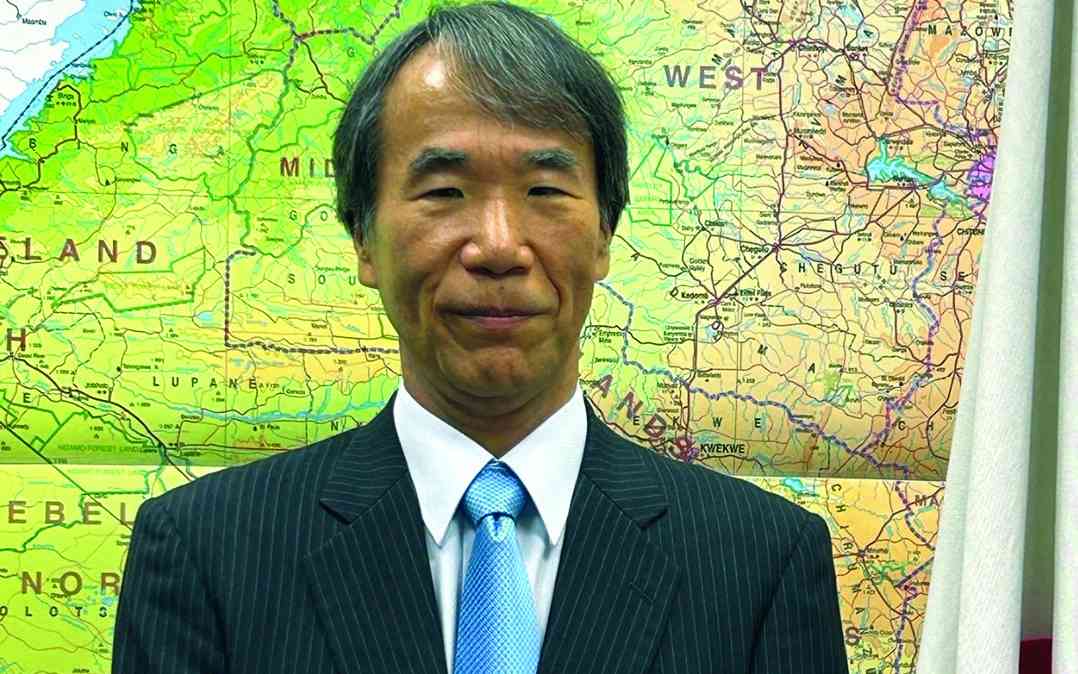
TRADE between Zimbabwe and Japan reached US$108 million in 2025. Zimbabwe imported goods worth about US$85 million from Japan, largely second-hand vehicles and machinery, while exports to the Asian economic powerhouse stood at US$23 million. Japanese Ambassador to Zimbabwe, Nobutaka Maekawa (NM, pictured) — hinting Zimbabwe’s economy is at a turning point — says the two nations are well-positioned to deepen cooperation in trade, investment, technology transfer and human capital development. With Japan’s economy valued at about US$4,3 trillion, Maekawa believes significant untapped opportunities remain across sectors including agriculture, mining, tourism, manufacturing and technology. Our deputy news editor, Tinashe Kairiza (TK), spoke to Maekawa about bilateral relations, trade growth, investment prospects and Zimbabwe’s economic outlook. Below are excerpts of the interview:
TK: Tell us about the diplomatic relationship between Japan and Zimbabwe?
NM: Japan and Zimbabwe have cultivated a robust relationship over the past 46 years, since Zimbabwe attained Independence. Japan has consistently stood by Zimbabwe, extending support and opportunities across various sectors based on the principles of Zimbabwean ownership and international partnership.
Since arriving in Harare, I have been deeply humbled by the warm appreciation and trust shown to me by the Zimbabwean people in the areas where Japan provides support across diverse fields. This forms the unshakable foundation of the values that bind our two countries.
While the free and open international order based on the rule of law faces serious challenges, the influence of the Global South, including Zimbabwe, continues to grow, and these countries are playing an increasingly significant role in the international community.
TK: How much trade was conducted between Zimbabwe and Japan last year?
NM: Zimbabwe is at a critical juncture as it embarks on the National Development Strategy 2 within the framework of Vision 2030. Deepening economic ties and promoting private-sector partnerships have become essential global trends, as highlighted at Expo 2025 Osaka, Kansai, and TICAD9.
Having consistently supported Zimbabwe’s development since Independence, Japan is committed to advancing economic and business cooperation in a tangible and co-creative manner.
- Cartoon: September 15, 2022 3dition
- Local energy firm bids to create employment
- Vision 2030 achievable if measures are taken to improve Zim economy
- Whose role is it to convert natural resources into decent employment?
Keep Reading
TK: Could you outline the support Japan has extended to Zimbabwe?
NM: This support includes trade, investment, technology transfer and human resource development, while continuing to mobilise development assistance to address economic, social and rural challenges that remain critical to the country. In 2025, imports from Japan reached around US$85 million, a 37% increase from the previous year and the highest level in 25 years. The main imports were vehicles and machinery.
TK: What factors contributed to this increase?
NM: The recent growth may have been driven by rising demand for Japanese products in Zimbabwe because of their price, quality and unique features. The main products are cars and delivery trucks.
To sustain this momentum, Japan maintains high-quality standards to build trust among Zimbabwean consumers, while collaborating with local businesses and drawing on their networks to better understand the market.
Exports to Japan in 2025 amounted to about US$23 million, a 28% increase from the previous year. The main exports were leaf tobacco, raw minerals and cotton.
TK: What should Zimbabwe do to boost exports to Japan?
NM: For Zimbabwe to build on this growth, it can adopt several strategies and focus on promising sectors such as agriculture, mining, manufacturing and infrastructure.
The automobile industry is one of Japan’s strongest sectors, and I believe Zimbabwe’s vehicle market still has significant potential, as evidenced by the popularity of fuel-efficient Japanese models such as the Honda Fit and Toyota Aqua.
With the development of the National Electric Mobility Policy, demand is likely to grow for hybrid and electric vehicles over the long term. This is particularly important given the increasing risks associated with climate change and the need to address high fuel costs and pollution from conventional vehicles.
TK: What opportunities can Zimbabwe and Japan exploit to expand bilateral trade?
NM: In the past, several Japanese companies, including globally-recognised corporations, operated in Harare as a strategic hub for southern Africa.
Today, however, our economic relationship remains concentrated in specific areas such as vehicle exports and imports of minerals and tobacco.
Given the strengths of our two nations, bilateral trade and investment still hold enormous untapped potential for growth.
TK: Are efforts to strengthen economic cooperation yielding results?
NM: At the Osaka Expo and TICAD9, there were extensive exchanges between government and business leaders from both countries. The signing of numerous memoranda of understanding with Japanese companies and institutions has planted many promising seeds for future cooperation.
In agriculture, we are witnessing strong synergies between Japanese private-sector initiatives and smallholder farmer support programmes. Through these partnerships, sesame production and exports to Japan show considerable promise. Other products, including cotton and coffee, are also attracting growing interest from Japanese investors.
In the mining sector, the memorandum of understanding between the Japan Organisation for Metals and Energy Security and Zimbabwe’s Ministry of Mines and Mining Development was upgraded following TICAD, enhancing technical cooperation in satellite-based remote sensing, joint analysis and field surveys for resource exploration.
Petalite, which Japan has imported from Zimbabwe for more than six decades for use in heat-resistant ceramics, remains an important mineral for Japan.
TK: Is Japan willing to share its advanced technologies with Zimbabwe?
NM: As critical minerals take centre stage globally, Japan is committed to sharing its advanced and environmentally-friendly technologies and expertise. We believe these will play an important role in strengthening Zimbabwe’s domestic processing capabilities and supporting sustainable industrial growth.
These efforts are already yielding results, with exports of sesame, petalite and coffee to Japan increasing.
In addition, Japanese companies such as Itochu Corporation and Pegara Japan are investing in Zimbabwe’s agriculture and technology sectors.
TK: What is your assessment of Zimbabwe’s human capital?
NM: The quality and potential of Zimbabwe’s human resources are widely recognised as among the country’s greatest strengths. Several Japanese companies and researchers are keen to support Zimbabwean youth in preparing for the global business environment.
About 200 aspiring Zimbabwean entrepreneurs and students participated last year in the Global AI Practitioner Course hosted by a leading AI laboratory at the University of Tokyo in partnership with Zimbabwean universities.
Participants were praised for their diligence, academic excellence and strong performance. This year, about 3 000 talented young Zimbabweans are expected to attend the course. Another internship programme has also been launched by Japanese AI companies. These initiatives demonstrate the promise of our bilateral efforts in human resource development in the AI era.
TK: What opportunities exist for cooperation in tourism?
NM: In the tourism sector, I am pleased to note that during the Zimbabwe Business Forum in Osaka last year, a mMemorandum of co-operation was signed between the Japan Tourism Agency and Zimbabwe’s Ministry of Tourism and Hospitality Industry.
Given Zimbabwe’s magnificent tourism assets, we expect a significant increase in Japanese visitors to this beautiful country. The content industry, including anime and manga, is another area where we are supporting the international expansion of Japanese companies.
Like other regions, Africa represents a promising market for this sector.
TK: How do you view Zimbabwe’s economic trajectory?
NM: We see the Zimbabwean economy at a turning point, entering a new era of growth. It is our sincere hope that sound macroeconomic management and consistent policy implementation under NDS2 will foster long-term stability and strengthen confidence in both the economy and the currency.
We also hope this will create a more attractive and investor-friendly business environment. Japan stands ready to support these efforts and contribute to a prosperous future for the people of Zimbabwe.