

ALPHA Media Holdings (AMH) will next month host a landmark summit poised to reshape how Zimbabwe attracts investment and delivers on its development agenda.
AMH is Zimbabwe’s biggest private media operation, presiding over high-end publications, including NewsDay, The Standard and the Zimbabwe Independent.
The group also controls Heart&Soul Television.
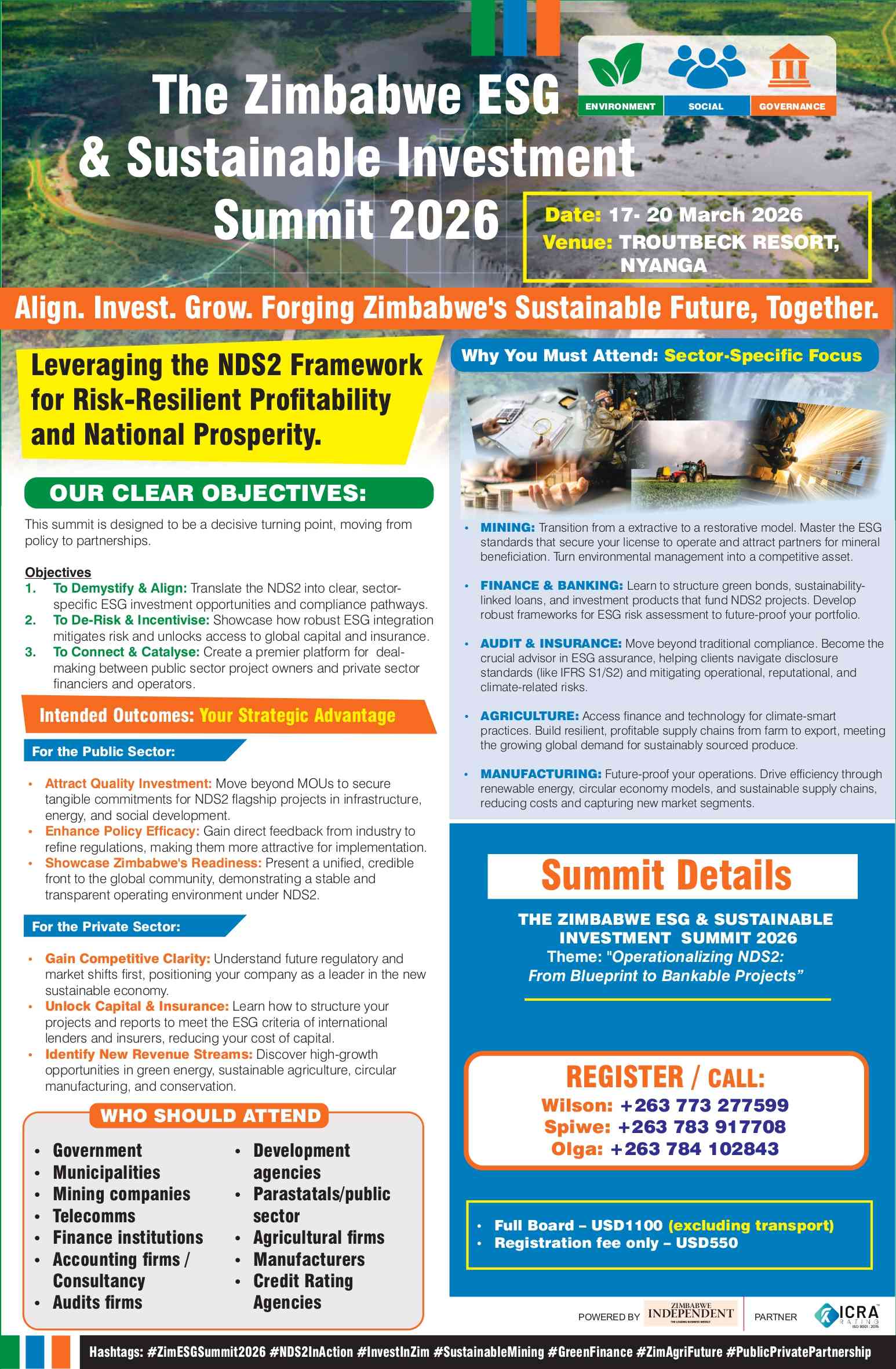
The Zimbabwe ESG & Sustainable Investment Summit 2026 will run from March 17 to 20 at Troutbeck Resort in Nyanga under the theme “Operationalising NDS2: From Blueprint to Bankable Projects.”
The summit will bring together government, business leaders and financiers to address a central question — how to convert national policy into profitable, sustainable and investable action.
ESG — Environmental, Social and Governance — refers to a set of criteria used to assess an organisation’s performance on sustainability, ethical conduct, risk management and long-term value-creation.
Globally, ESG has become a critical lens through which investors evaluate markets and projects.
- The only market where knowledge exchange is part of customer experience
- Dave Chappelle: US comedian attacked on stage in Los Angeles
- AMH investor forum to explore Zim opportunities
- Is Zimbabwe ready for green building standards?
Keep Reading
At the 2023 United Nations Climate Change Conference (COP28), countries reaffirmed commitments to accelerate emissions reduction plans towards net zero by 2050, reinforcing the global shift toward sustainable finance.
Against this backdrop, the Zimbabwe ESG & Sustainable Investment Summit 2026 comes at a critical moment. As global capital tightens and sustainability becomes non-negotiable, the ability to align national policy with investor expectations will increasingly determine which economies thrive and which are left behind.
The summit’s ambition is to move beyond statements of intent and create practical pathways for ESG integration that unlock capital, manage risk and drive national prosperity.
For years, ESG has often been viewed by some local players as a compliance burden or a donor-driven agenda. This summit seeks to change that narrative by demystifying ESG and translating the National Development Strategy 2 (NDS2) into clear, sector-specific investment opportunities and compliance pathways. In doing so, it aims to demonstrate that sustainability, when properly structured, is not a cost centre, but a source of resilience and long-term profitability.
The summit is guided by the vision: “Align. Invest. Grow. Forging Zimbabwe’s Sustainable Future Together — Leveraging the NDS2 Framework for Risk-Resilient Profitability and National Prosperity.”
Key objectives include translating NDS2 into bankable ESG-aligned projects, showcasing how robust ESG integration can de-risk investments and unlock access to global capital and insurance, and creating a premier platform for deal-making between public sector project owners and private sector financiers and operators.
The event is designed to attract quality investment by moving beyond memoranda of understanding towards securing tangible commitments for NDS2 flagship projects in infrastructure, energy and social development. It also aims to enhance policy efficacy by facilitating direct feedback from industry, helping refine regulations to improve implementation and investor appeal.
In addition, the summit will showcase Zimbabwe’s readiness to the global community by presenting a unified and credible front, demonstrating a stable and transparent operating environment anchored in NDS2.
For the private sector, the summit will provide clarity on future regulations and market shifts, while positioning participating firms as leaders in the emerging sustainable economy.
The event is open to a broad range of stakeholders, including government ministries, municipalities, mining houses, telecommunications firms, financial institutions, accounting and consultancy firms, audit and insurance companies, development agencies, parastatals, agricultural enterprises, manufacturers and credit rating agencies.
Participants will gain insights into structuring projects and reporting frameworks that meet the standards of international lenders and insurers, helping reduce the cost of capital, improve access to finance and open new revenue streams — particularly in green energy, sustainable agriculture, circular manufacturing and conservation, sectors aligned with Zimbabwe’s resource base.
Mining sector participants will explore how restorative extraction models, strengthened environmental management, community engagement and sound governance can secure social licence to operate and attract partners for mineral beneficiation.
For finance and banking institutions, the focus will be on structuring green bonds, sustainability-linked loans and ESG-aligned investment products capable of funding NDS2 priorities, while strengthening risk assessment frameworks.
Audit and insurance professionals will examine how to move beyond traditional compliance into ESG assurance, advising clients on disclosure standards such as International Financial Reporting Standards S1 and S2, and mitigating climate, operational and reputational risks.
Agriculture discussions will centre on climate-smart practices, resilient supply chains and access to finance and technology required to meet export market sustainability standards.

Manufacturers, meanwhile, will be challenged to future proof operations through renewable energy adoption, circular economy models and sustainable supply chains that reduce costs while opening new markets.