THE Zimbabwe Stock Exchange (ZSE) faces a significant liquidity shock and a potential blow to its credibility following plans by its largest listed company, Econet Wireless Zimbabwe, to voluntarily delist.
Announced this week, the telecoms giant’s intention to exit the local bourse, on the grounds that its shares are “grossly undervalued”, could erase more than US$700 million from the ZSE’s market capitalisation.
Market analysts warn that the departure of one of the exchange’s most liquid and widely held counters risks undermining investor confidence and may prompt other large companies to reassess their listings.
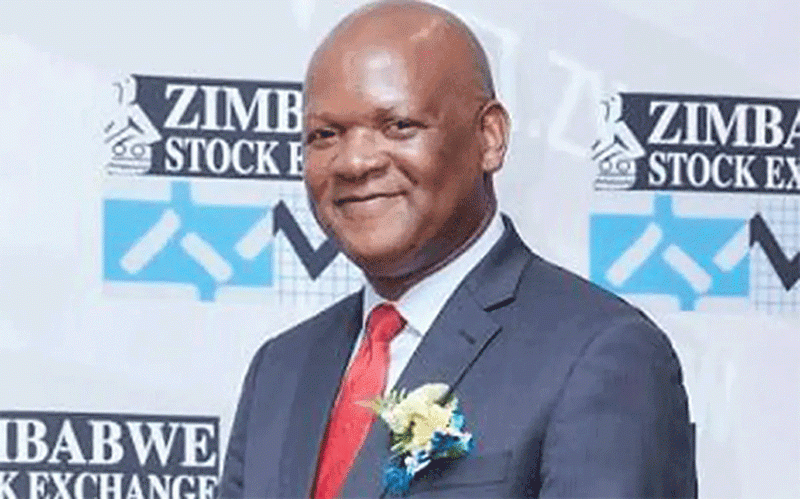
ZSE Holdings chief executive Justin Bgoni expressed the exchange’s disappointment in an interview with the Zimbabwe Independent.
“Econet is pursuing a voluntary delisting, which is a business decision on their part. Yes, we regret that they are delisting, given that their counter is actively traded,” he said.
Bgoni stressed, however, that the group would remain publicly listed.
“Despite pursuing delisting from the ZSE, they will also pursue a listing on the VFEX (Victoria Falls Stock Exchange),” he said.
“This means we have not lost them completely; they are bringing a new type of investment to VFEX, which has proven to be successful in other countries.”
- Mboweni mentors emerging entrepreneurs, calls for integrity in business
- Mboweni mentors emerging entrepreneurs, calls for integrity in business
- Zim tycoons elevate offspring to key roles
- Zim tycoons elevate offspring to key roles
Keep Reading
Bgoni cautioned that the process was still at an early stage, noting that full public disclosure would follow board approval of a formal application.
The proposed delisting has heightened anxiety among local investors. Econet has long been regarded as a hedge against inflation, and its exit could see substantial value wiped out of retail portfolios.
Financial securities analyst Kudakwashe Taimo said Econet’s rationale was understandable from a corporate perspective.
“From Econet’s perspective, the rationale is clear. The company has repeatedly cited chronic undervaluation on the ZSE, trading at a significant discount to regional peers despite owning valuable infrastructure assets such as towers, real estate, and power installations,” he said.
Taimo said the proposed restructuring, which involves separating passive infrastructure assets into a new entity, InfraCo, for listing on the VFEX, was designed to unlock value that the market had failed to reflect.
“The proposed restructuring... aligns with global best practice and aims to unlock value that the local market has arguably failed to recognise,” he said.
However, Taimo said the move also exposed long-standing structural weaknesses at the ZSE.
“Persistent pricing distortions, currency woes, and unresolved legacy issues, most notably around suspension of counters such as Old Mutual and PPC, have continued to undermine confidence in the ZSE,” he said.
“Without credible solutions to these long-standing challenges, the risk of further high-quality counters opting to delist cannot be dismissed.”
While Econet has proposed an exit mechanism that includes cash payments and shares in InfraCo, Taimo said investors would still lose an important benefit.
“This offers a degree of protection for minority investors, it does not fully compensate for the loss of a liquid secondary market should the delisting proceed,” he said.
Market reaction has been mixed, reflecting uncertainty around the proposal.
“Following the initial cautionary announcement on December 3, the stock rallied sharply as investors anticipated value unlocking,” Taimo said.
“However, the release of the further cautionary (dated December 15) has been met with selling pressure, reflecting uncertainty around post-delisting liquidity and valuation outcomes.”
He said the forthcoming extraordinary general meeting (EGM) would be pivotal.
“Ultimately, the outcome of the EGM will be decisive, not only for Econet shareholders, but for the direction of Zimbabwe’s equities market,” the analyst said.
“If approved, Econet’s exit would underscore the urgency for the ZSE, regulators, and the Ministry of Finance and Economic Development to address market depth, liquidity, and credibility concerns.
“Failure to do so risked accelerating a trend where the country’s most valuable companies increasingly look beyond the ZSE to unlock shareholder value.”
The proposed departure comes at a delicate moment for the exchange, which recently surpassed a total market capitalisation of US$3 billion, highlighting the fragility of the milestone.