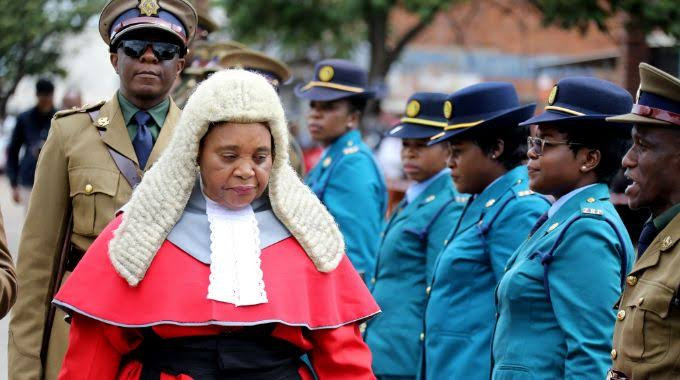
WHEN Elizabeth Gwaunza became Zimbabwe's first female Chief Justice in May 2026, history recorded a first. But history often underestimates moments that quietly change institutions forever.
This was not simply about appointing the first woman to the country's highest judicial office. It was about Zimbabwe finally crossing a constitutional threshold that many democracies have struggled to reach: proving that leadership at the highest level of the judiciary is determined by competence rather than tradition.
For decades, Zimbabwe's courts reflected a familiar African reality. Women entered the legal profession in growing numbers, became accomplished lawyers, prosecutors and judges, yet the very top of the judicial hierarchy remained almost exclusively male. It was not because capable women were absent. It was because invisible institutional barriers — the so-called "glass ceiling" — proved remarkably resilient.
Justice Gwaunza's elevation shattered that final barrier.
Critics sometimes dismiss such appointments as symbolic. They are wrong.
Symbols matter because institutions are built on them. The first female Chief Justice tells every young law student that the highest judicial office is attainable. It tells every judge that excellence, not gender, defines leadership. Most importantly, it tells the public that the judiciary is capable of evolving without compromising merit.
What makes Gwaunza's appointment particularly significant is that it was never a case of representation replacing competence. Her career speaks for itself.
She served as a High Court judge, Supreme Court judge, Constitutional Court judge and Deputy Chief Justice.
- ‘Govt spineless on wetland land barons’
- Businessman locks horns with top judges
- Salah named Footballer of the Year
- Businessman locks horns with top judges
Keep Reading
She also gained international judicial experience and spent decades building a reputation for integrity and judicial professionalism before assuming the country's highest judicial office. Her appointment therefore strengthened, rather than diluted, the principle that merit must remain the foundation of judicial leadership.
This distinction is important because debates on gender equality often create a false choice between merit and inclusion.
Mature constitutional democracies reject that argument. The real question is whether equally qualified people are prevented from reaching leadership because of historical barriers. Zimbabwe's judiciary has now demonstrated that those barriers can be removed without lowering standards.
The significance extends well beyond Zimbabwe.
Across Africa, constitutional democracies are gradually rewriting the story of judicial leadership. Kenya appointed Martha Koome as Chief Justice. South Africa elevated Mandisa Maya. Rwanda has become recognised for women's leadership in public institutions. Zimbabwe's appointment of Gwaunza places the country firmly within this continental movement towards more representative and more legitimate constitutional institutions.
This is why Gwaunza's appointment should be viewed as a tipping point rather than merely a milestone.
A milestone celebrates an achievement.
A tipping point changes the direction of history.
After May 2026, no Zimbabwean can credibly argue that the office of Chief Justice is reserved — whether by convention or culture — for men. The highest judicial office has become genuinely open to every jurist with the experience, integrity and constitutional qualifications to lead it.
That change carries consequences far beyond the courtroom.
Representative institutions command greater public confidence because citizens are more likely to believe that opportunity is genuinely available to all.
A judiciary that reflects the society it serves strengthens constitutional legitimacy, not because judges should decide cases differently according to gender, but because the institution itself demonstrates fidelity to the constitutional values of equality and fairness.
Of course, one appointment does not eliminate every structural obstacle facing women in law. Judicial transformation cannot rest on a single individual. It requires sustained investment in legal education, transparent appointments, professional development and equal opportunity throughout the legal profession.
Yet every transformation has its defining moment.
For Zimbabwe, Gwaunza's appointment was that moment.
It marked the point at which constitutional promises became constitutional practice; when decades of gradual reform finally reached the highest office in the land; and when Zimbabwe joined a growing group of African nations demonstrating that judicial excellence and gender inclusion are not competing ideals but complementary pillars of constitutional democracy.
Years from now, historians may remember Gwaunza as Zimbabwe's first female Chief Justice.
Constitutional scholars, however, are more likely to remember her as the jurist whose appointment marked the moment Zimbabwe's judiciary finally crossed from historical exclusion into institutional transformation.